
Every bottle of carbonated water, every can of cola, every craft soda starts with the same invisible ingredient: carbon dioxide. Most consumers never think about where that CO2 comes from. But for beverage manufacturers, CO2 quality is one of the most critical factors that determines taste, safety, and shelf life.
In India's fast-growing beverage market — projected to reach $24 billion by 2028 — the demand for reliable, high-purity food-grade CO2 has never been higher. Here's why it matters, and what manufacturers should look for when choosing a CO2 supplier.
What Makes CO2 "Food-Grade"?
Not all carbon dioxide is created equal. Industrial-grade CO2, used in welding, fire suppression, and chemical processes, may contain trace contaminants that are acceptable for those applications but harmful in food and beverages.
Food-grade CO2 must meet stringent purity standards:
- Minimum 99.9% purity (many premium applications require 99.99%+)
- Compliance with FSSAI (Food Safety and Standards Authority of India) regulations
- Adherence to ISBT (International Society of Beverage Technologists) guidelines
- Certified under FSSC 22000 food safety management system
These certifications are not optional quality badges — they represent legally mandated safety thresholds that protect consumers from harmful contaminants.
How Impurities Affect Your Product
The most common CO2 contaminants — and their effects on beverages — include:
- Benzene & hydrocarbons: Even at parts-per-billion levels, these introduce a chemical aftertaste and pose long-term health risks
- Sulfur compounds: Create "off" odours — the rotten-egg smell that consumers immediately associate with spoilage
- Acetaldehyde: Imparts a green-apple or solvent-like flavour, particularly noticeable in water and light beverages
- Moisture: Excess water content accelerates corrosion in carbonation systems and can harbour microbial growth
Key Fact: A human palate can detect flavour changes from CO2 impurities at concentrations as low as 0.1 parts per million. What seems like a negligible trace in laboratory terms is clearly perceptible in a glass of sparkling water.
The Supply Chain Factor
CO2 purity at the point of production is only half the equation. How that CO2 is stored, transported, and delivered matters just as much.
Contamination can enter the supply chain at multiple points:
- Tanker cross-contamination: If a transport vessel previously carried industrial-grade CO2 or other chemicals without proper cleaning
- Storage tank integrity: Ageing or poorly maintained storage tanks can introduce rust particles and moisture
- Pipeline and connection points: Every junction is a potential ingress point for ambient air and moisture
This is why choosing a CO2 supplier is not just about the product specification on paper — it's about the supplier's infrastructure, fleet condition, cleaning protocols, and quality management systems across the entire chain.
What Beverage Manufacturers Should Look For
When evaluating a food-grade CO2 supplier, these are the non-negotiable criteria:
- Complete certification stack: FSSAI + FSSC 22000 + ISO 9001, at minimum. ISBT compliance for premium beverage applications.
- Dedicated food-grade infrastructure: Separate storage and transport for food-grade vs. industrial-grade CO2. Shared infrastructure is a red flag.
- Batch traceability: The ability to trace any delivery back to its production batch, storage history, and transport vessel.
- Strategic storage proximity: Shorter transport distances mean less time for potential contamination and faster delivery for just-in-time production schedules.
- Consistent supply capability: Beverage production cannot afford CO2 shortages. The supplier's production capacity, storage reserves, and geographic spread matter.
SICGIL's Approach to Food-Grade CO2
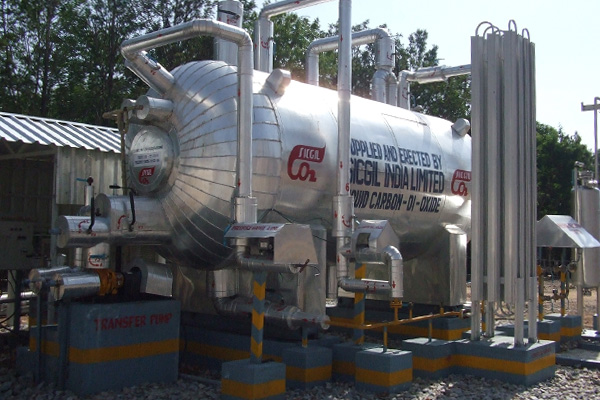
SICGIL India Limited operates the largest CO2 and dry ice production capacity in India, with manufacturing facilities and strategic storage locations across the country. Our food-grade CO2 meets FSSAI, FSSC 22000, and ISO 9001 standards, with the infrastructure to maintain purity through the entire supply chain — from production to the customer's carbonation line.
With dedicated food-grade storage, a modern tanker fleet, and real-time IoT telemetry monitoring of customer-site tanks, we ensure that the CO2 reaching your production line is as pure as when it left our facility.
To learn more about our High Purity CO2 solutions, or to request a quote for your beverage manufacturing facility, contact us today.
Frequently Asked Questions
What is the difference between food-grade CO2 and industrial-grade CO2?
Food-grade CO2 must meet a minimum purity of 99.9% and comply with FSSAI and ISBT standards. Industrial-grade CO2 typically has lower purity requirements and may contain trace contaminants such as benzene, acetaldehyde, or sulfur compounds that are unsafe for human consumption.
What certifications should a food-grade CO2 supplier have?
A reputable food-grade CO2 supplier should have FSSAI certification, FSSC 22000, ISO 9001 quality management certification, and ideally ISBT compliance for the beverage industry. SICGIL India Limited holds all of these certifications.
How does CO2 purity affect the taste of carbonated beverages?
Even trace impurities at parts-per-billion levels can introduce off-flavours, metallic aftertaste, or unpleasant odours. Contaminants like benzene, sulfur compounds, and hydrocarbons are the most common sources of flavour degradation. High-purity food-grade CO2 (99.9%+) ensures clean, consistent carbonation.